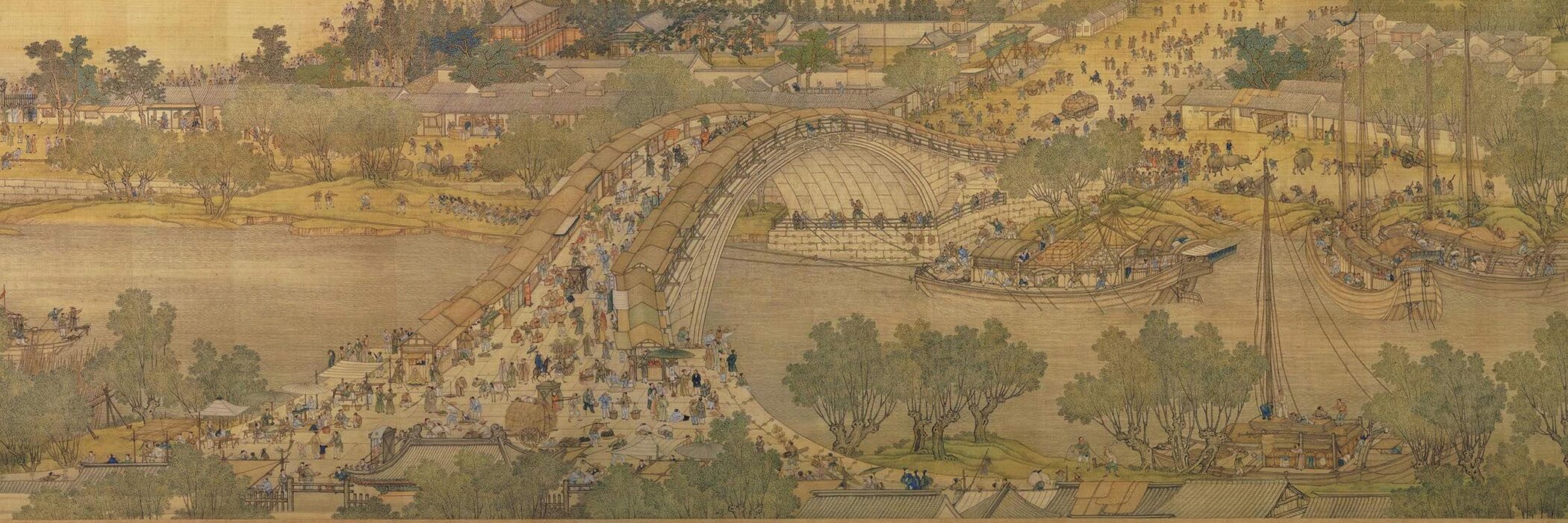
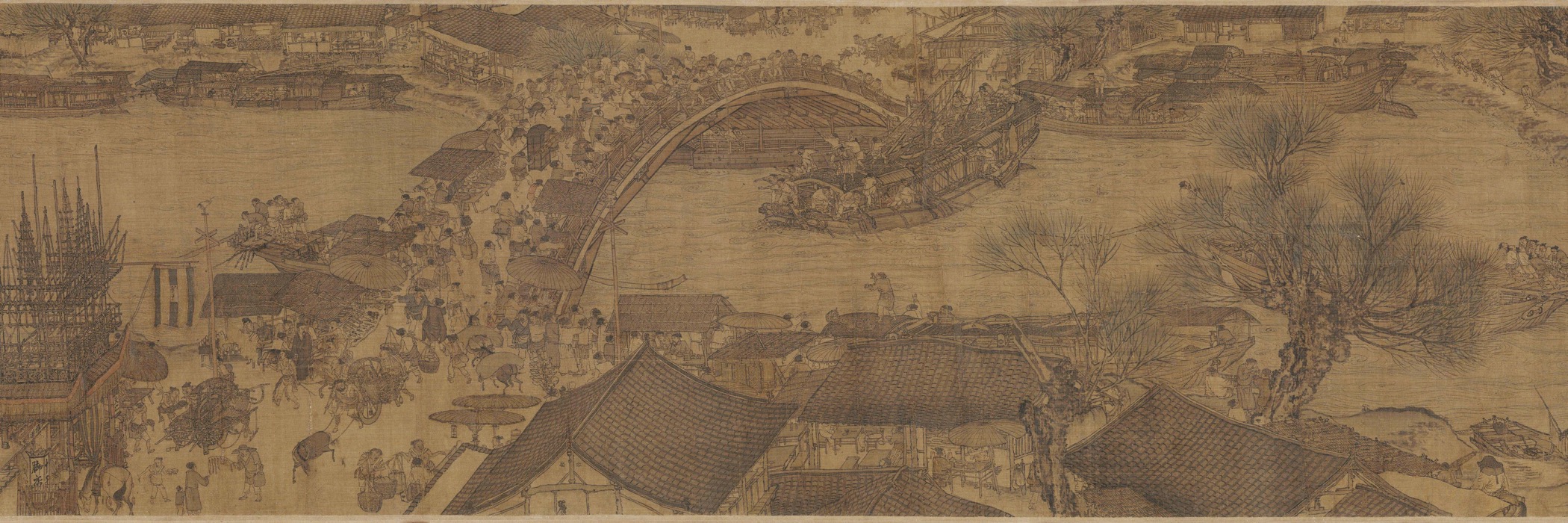

The Qing Court version reworks an established subject using later pictorial models and Ming and Qing customs. It is neither a color reconstruction nor a simple enlargement of the Song scroll. The shared motifs do not establish that both paintings depict the same actual river and city. National Palace Museum, Taipei
Catalog data follow the two museums’ records. Scholarly interpretations are attributed to their authors; comparative judgments are the article’s own.
The two works
Here, “the original” means Zhang Zeduan’s Northern Song scroll in the Palace Museum, Beijing (the Song scroll, below). “The Qing Court version” means the collaborative work by five court painters now in the National Palace Museum, Taipei (the Qing version). Palace Museum, Beijing National Palace Museum, Taipei
| Item | Zhang Zeduan’s Northern Song scroll | Qing Court version |
|---|---|---|
| Title | Along the River During the Qingming Festival 清明上河圖 | Along the River During the Qingming Festival, Qing Court version 清院本清明上河圖 |
| Date | Usually placed in the late Northern Song, early 12th century | 1736, the first year of Qianlong, in the museum catalog |
| Artists | Zhang Zeduan 張擇端 | Chen Mei 陳枚, Sun Hu 孫祜, Jin Kun 金昆, Dai Hong 戴洪, Cheng Zhidao 程志道 |
| Medium and format | Ink and light color on silk, handscroll | Ink and colors on silk, handscroll |
| Size | 24.8 cm high × 528 cm long | 35.6 cm high × 1,152.8 cm long |
| Collection | Palace Museum, Beijing | National Palace Museum, Taipei |
The Qing version is about 2.18 times as long (1,152.8 ÷ 528) and has about 3.13 times the painting-surface area ((35.6 × 1,152.8) ÷ (24.8 × 528)). These ratios compare the museums’ recorded dimensions of the painting sections, excluding the mounting. Palace Museum, Beijing NPM, Taipei: collection record
The Qing version is also notable for coordinating the specialties of five court painters across this unusually extended composition. National Palace Museum, Taipei
Cheng-hua Wang identifies the Qing version as a project commissioned under Yongzheng and completed early in Qianlong’s reign. This article retains the museum’s date of 1736. Wang uses 1737, corresponding to the Western-calendar date of completion in the twelfth lunar month of Qianlong’s first year. The two year labels refer to the same work. Wang, Archives of Asian Art
Composition: connections and spatial expansion
The Song scroll: transport and adjoining activities
The Song scroll proceeds from the countryside through the river and Rainbow Bridge to the city gate and streets. The bridge joins water transport, road traffic and commerce within a concentrated area. Palace Museum, Beijing
- Countryside
- River and Rainbow Bridge
- City gate and streets
Boats, cargo handling, porters and shops provide subjects for examining the relationship between transport and trade. This article reads their proximity as a compositional connection between activities, rather than treating each group as an isolated scene. UW Sourcebook
The Qing version: additional settings and episodes
The Qing version retains the countryside, bridge and city gate while extending the sequence to scholars’ gardens, an imperial garden and Lake Jinming. These settings increase the range of activities included in the scroll. National Palace Museum, Taipei
- Countryside
- Bridge
- City gate
The distinction proposed here concerns emphasis: the Song scroll connects activities along a transport route; the Qing version gives more space to distinct settings and local episodes. This is a comparative reading, not a measured difference in density.
Viewing sequence
Handscrolls are viewed progressively from right to left, exposing one section at a time. Transitions between sections therefore matter alongside the arrangement of the complete image. A full-width digital reproduction changes that viewing condition. UW Sourcebook
Technique: line, color and perspective
Line and color
The Song scroll uses ink and light color on silk; it is not a monochrome ink painting. Palace Museum, Beijing The Qing version uses more prominent color and detailed delineation of figures and architecture. National Palace Museum, Taipei
| Element | Song scroll | Qing version |
|---|---|---|
| Line | Articulates figures, gestures, boats and buildings | Delineates figures, objects and architectural ornament |
| Color | Light washes used with ink outlines | More prominent color across clothing, buildings and gardens |
Resolution, photography and image processing can affect the appearance of these reproductions. Screen sharpness and saturation alone cannot establish either the painters’ relative skill or the paintings’ original colors.
Viewpoint and perspective
The Song scroll connects spaces through changing viewpoints. Palace Museum, Beijing For the Qing version, the National Palace Museum, Taipei specifically identifies Western influence in perspective rendering and the inclusion of Western-style buildings. National Palace Museum, Taipei
Local perspective effects can coexist with the continuous space of a handscroll. They do not require the entire Qing composition to follow a single vanishing point.
Narrative: events and onlookers
The Song Rainbow Bridge
Under the Rainbow Bridge, a boat lowers its mast to pass beneath the structure while crew members work and people nearby watch. Palace Museum, Beijing
The scene connects the crew’s actions with the attention and movement of people on the bridge. Its compositional concentration comes from the way one event coordinates several groups’ actions and responses, rather than from the number of figures alone.
The bridge itself also changes. The Song original shows the exposed timber framework of a wooden arch; in the Qing detail, masonry joints along the arch and rows of roofed stalls stand out. “Rainbow Bridge” is a shared motif, but the structure and the arrangement of boats and people differ between the two paintings. Palace Museum, Beijing National Palace Museum, Taipei
Episodes in the Qing version
Cheng-hua Wang discusses a fight surrounded by onlookers, a rider about to fall from a donkey and misbehaving schoolboys. Her analysis emphasizes theatricality and spectatorship: figures watching an event help organize it as a distinct narrative unit. Cheng-hua Wang
Both works include disruption, work and spectators. The useful comparison is how these elements are arranged.
Social representation: work, leisure and gender
Work and exchange
In the Song scroll, shop signs, stalls, cargo and transport provide evidence for studying commercial activity. Load carriers and passengers also occupy different roles within the same street. UW Sourcebook Their arrangement can be examined in terms of work, access to transport and social status, without assuming that the scene represents the population as a whole.
Additional settings for leisure
The Qing version includes farmers, laborers, boatmen and peddlers alongside gardens and performances. NPM, Taipei: collection record The comparison therefore concerns the distribution of work and leisure across the composition, not the replacement of labor by entertainment.
Women and represented space
Women in the Song scroll include passengers inside covered sedan chairs, as the University of Washington guide notes. UW Sourcebook In the Qing version, Wang examines women’s activities within enclosed palace gardens and the viewer’s access to those spaces. Cheng-hua Wang
Greater visibility within a painting is not evidence, by itself, of greater social freedom. The figures’ locations, the boundaries around them and the viewpoint used to show them need to be considered separately from claims about historical changes in women’s lives.
Political interpretations and later inscriptions
Yu Hui’s reading of the Song scroll
Palace Museum scholar Yu Hui 余輝 interprets the danger to boats, traffic congestion and weaknesses in public services as signs of problems beneath urban prosperity. His lecture is published by the Palace Museum, Beijing. Yu Hui: Palace Museum lecture
This is Yu Hui’s interpretation, not established evidence of Zhang Zeduan’s intention. Valerie Hansen proposes a different account, reading the city as idealized rather than as a faithful representation of Kaifeng. These readings show that identifying the subject and interpreting its political purpose remain separate questions. Hansen (PDF)
The Qing court’s use of an earlier tradition
Wang relates the Qing version to Yongzheng’s and Qianlong’s cultural agendas: inherited subjects were reworked through court production. This interpretation concerns patronage and institutional practice; it should not be substituted for evidence of each painter’s individual purpose. Wang, Archives of Asian Art
Qianlong’s poem of 1742
The museum record preserves a poem by Qianlong dated 1742, written out by Liang Shizheng and attached to the scroll’s mounting. Its final couplet names Huizong and Qinzong. NPM, Taipei: collection record
當時誇豫大,此日歎徽欽
Back then they boasted of abundance and grandeur; today we sigh over Huizong and Qinzong.
The couplet places prosperity beside the later judgment of the last two Northern Song emperors. It supports a reading of the inscription as historical caution. The painting, its original production and this later imperial response should be analyzed separately.
Historical evidence: uses and limits
The Song scroll and urban life
Shop signs, trade and transport in the Song scroll can be studied alongside written and archaeological evidence of urban life. A painted detail establishes what is represented; its relationship to a specific historical practice requires further evidence. UW Sourcebook
The usual identification with Kaifeng does not make the scroll a survey of that city. Selection and rearrangement are part of its composition, and the extent of its correspondence with actual topography is debated. Hansen (PDF)
The Qing version and later customs
The Qing version incorporates Ming and Qing customs into an inherited subject. Its buildings, clothing and entertainments cannot therefore be treated directly as evidence for twelfth-century Kaifeng. They also document later choices about how the past should be represented. National Palace Museum, Taipei
Representations of urban work, exchange and transport in a Song-period painting.
The eighteenth-century court’s adaptation of earlier models and later customs.
Assessment by criterion
The table pairs each judgment with the criterion and visual basis behind it.
| Criterion | Emphasis in this assessment | Basis |
|---|---|---|
| Historical influence | Song scroll | Its role as a reference for later versions of the subject |
| Compositional integration | Song scroll | The connection between transport routes, work and adjoining street activity |
| Concentration of a central event | Song scroll | The coordination of actions and responses around the boat at the Rainbow Bridge |
| Color and architectural detail | Qing version | The extent of colored detail across buildings, gardens and figures |
| Variety of settings and episodes | Qing version | Distinct groups of activity distributed across streets, gardens and performance spaces |
The National Palace Museum’s exhibition account identifies Zhang Zeduan’s scroll as a model for later versions. That historical role is distinct from this article’s judgment about the integration of its scenes. National Palace Museum, Taipei
Giving priority to historical influence and compositional integration, this assessment favors the Song scroll. The Qing Court version stands as an independent achievement in adapting earlier models and arranging a wide range of settings and episodes.
Sources
- Palace Museum, Beijing. Collection record: Along the River During the Qingming Festival (Zhang Zeduan)
- National Palace Museum, Taipei. Selected works: the Qing Court version
- National Palace Museum, Taipei. Exhibition site: Along the River During the Qingming Festival
- National Palace Museum, Taipei, Digital Archive. Catalogue record of the Qing Court version, including Qianlong’s 1742 poem
- Field Museum. Cyrus Tang Hall of China: the late Ming scroll; collection description: a later copy dated to the late 16th or 17th century.
- Cheng-hua Wang, “One Painting, Two Emperors, and Their Cultural Agendas: Reinterpreting the Qingming Shanghe Painting of 1737,” Archives of Asian Art 70, no. 1 (2020): 85–117. doi:10.1215/00666637-8124988; Academia.edu
- University of Washington, A Visual Sourcebook of Chinese Civilization: the Qingming scroll; urban commerce; transport and passengers
- Valerie Hansen, “The Mystery of the Qingming Scroll and Its Subject: The Case Against Kaifeng,” Journal of Sung-Yuan Studies 26 (1996): 183–200. Yale History (PDF)
- Yu Hui, Palace Museum, Beijing. Lecture transcript: “Revealing the Northern Song Qingming Scroll by Zhang Zeduan” (lecture, September 22, 2012; published October 26, 2012)